
Neighbourhood safety - what to check before buying an apartment
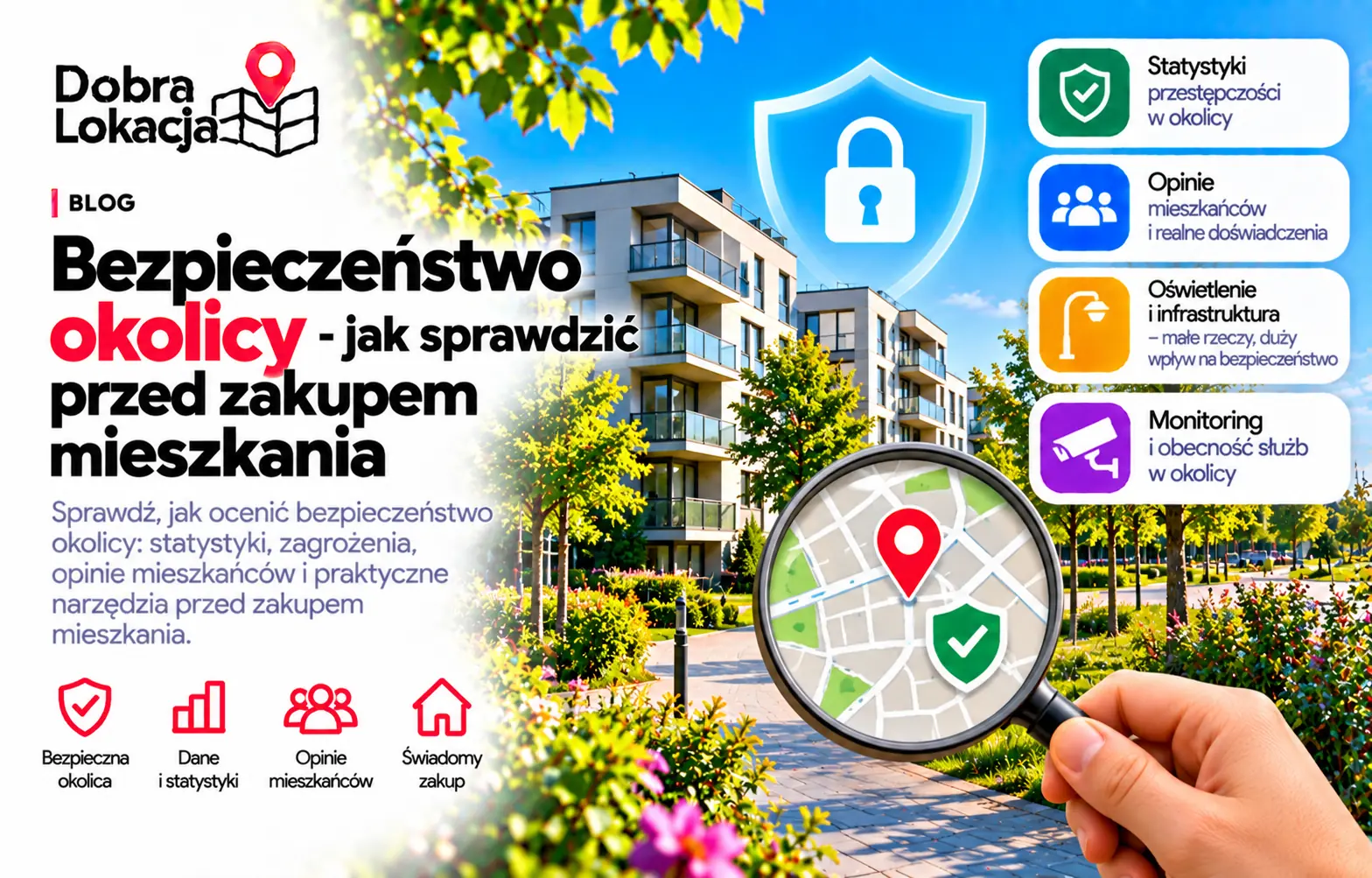
Assess the exact address before signing a contract. Combine official sources, conversations with residents and visits at different times. A district's reputation alone cannot tell you whether a particular home will suit your everyday life.
Why is neighbourhood safety so important?
Safety around your home should be one of the first considerations when looking for somewhere to live. It is not only about crime statistics: it also means everyday comfort, peace of mind and being able to move around at different times of day and night.
Many people ask whether an area is safe only after moving in. Assess it before signing a contract, using several sources rather than one impression.
- How to check neighbourhood safety before buying
- What to observe during visits
- Where to find crime data for Warsaw
- How to compare addresses without relying on a district's reputation
- How safety relates to property value
How to check neighbourhood safety
Combine data analysis with personal observation. Each source answers different questions, so use visits, police information and conversations with residents together.
1. Visit at different times of day and night
Visiting is an essential part of assessing an area. Check how the same streets change during the week.
- Weekday mornings: observe everyday activity and traffic
- After dark: check street lighting and pedestrian activity
- Weekends: see how the neighbourhood is used during leisure time
- At night: assess whether it is quiet or noisy
2. Police statistics and safety maps
Warsaw Metropolitan Police publishes information on crime in individual districts. Review available reports and check their period and geographic coverage.
- The number of reported offences in the area
- The most common types of violations
- Changes over time
- The location of police stations
3. Talk to residents
People who have lived locally for years can describe everyday conditions. Ask several residents rather than relying on a single opinion.
- Do they feel safe locally?
- Have there been unpleasant incidents?
- What is their experience of the immediate surroundings?
- Would they recommend the location to a family with children?

Signs to check during a viewing
Look at practical conditions and maintenance. These observations help you ask better questions, but individual visual signs are not proof that an area is safe or unsafe.
Positive signs
- Working street lights and illuminated courtyards
- Maintained buildings and clean shared spaces
- People walking and using public spaces
- Operating shops and everyday services
- Playgrounds used by families
- Public cameras at relevant locations
Issues to investigate
- An unlit route home: check visibility and an alternative route
- Damaged buildings, broken windows and neglected public space
- Repeated aggressive behaviour: ask about specific incidents and dates
- Closed shops or premises: ask about the reasons
- Faulty entrance doors: check how faults are reported and repaired
Children's safety: what to look for
Families should assess the places children will actually use, including the route to school and the nearest playground. A peaceful-looking estate is only part of the picture.
- A safe school route: pavements, crossings, traffic lights and supervision near schools
- Fenced playgrounds away from busy roads, with appropriate impact surfaces
- Traffic calming: 30 km/h zones, speed humps and limited through traffic
- Parks and small green spaces suitable for play
- Nearby nurseries, kindergartens and after-school facilities

How to read safety maps and statistics
No single measure establishes that an entire district is safe. Compare the same period, incident type and geographic coverage. Raw totals also depend on population, visitors and traffic. No reports does not guarantee no problems.
The National Safety Threat Map lets you browse reported threats. Check categories and report statuses; its points are not a full register of all crimes or a street ranking. It is not for requesting urgent intervention.
Local police reports add context, but district data does not automatically describe one building. Compare resident opinions with several independent accounts and ask about dates, locations and incident types.
Check the whole route home
Walk the actual route from the stop, parking space or school to the entrance. After dark, assess working lights, visibility at crossings, continuous pavements and alternative routes. Look for obscured driveways and places where pedestrians must step into the road.
Compare a weekday and a weekend. Record concrete observations: a broken street light, fast traffic near a school or an entrance door that does not close. The appearance of passers-by, the age of buildings or a single mark on a wall cannot establish the risk.
Questions for the building manager
For addresses near rivers, also check the official flood hazard and risk maps from Wody Polskie. This is a separate risk. Ask about local flooding of garages and basements too.
- Do entrance doors and the intercom work, and how quickly are faults repaired?
- Have break-ins to basements, garages or bicycle rooms been reported, and what action followed?
- Do the entrance, access route and garage lights work?
- How do residents report faults and recurring disturbances?
- Has the building or garage flooded during heavy rain?
Safety and apartment prices
Do not attribute a price difference solely to safety. Transport, building condition, size, floor and finish matter as well. Compare similar properties and the specific costs of security measures and repairs. A higher price or estate security does not guarantee an absence of incidents.
A practical neighbourhood safety checklist
Before deciding to buy or rent, work through these checks and note anything that still needs clarification.
- Visit at different times: daytime, evening, night and weekend
- Review local police statistics
- Speak with at least three residents
- Assess street and shared-space lighting
- Check whether surveillance cameras are present
- Inspect buildings and public-space maintenance
- Check the distance to a police station
- Assess vehicle traffic, especially for children
- Read local forums and community groups
- Inspect building security: intercom, cameras and guards
Summary
Neighbourhood safety is an important part of choosing a home. Statistics alone are not enough: visit the area, speak with residents and evaluate actual conditions.
A safer environment is about more than crime risk. It also affects daily comfort and family life. Treat it as part of a broader housing decision rather than a promise of financial returns.
When choosing a home in Warsaw, use the available maps, police data and resident feedback together to make an informed decision.
Official tools and their limits
The Police National Safety Threat Map lets you review reported threats and their statuses. It is not a complete register of crime or a street ranking and is not for urgent interventions. For riverside properties, also check the official flood hazard and risk maps from Wody Polskie. Flood exposure is a separate risk from crime.
Related reading
Check the location
Our map helps compare transport, schools, services and green spaces. Its location score is not a crime-risk assessment or a guarantee of safety.
Check the location